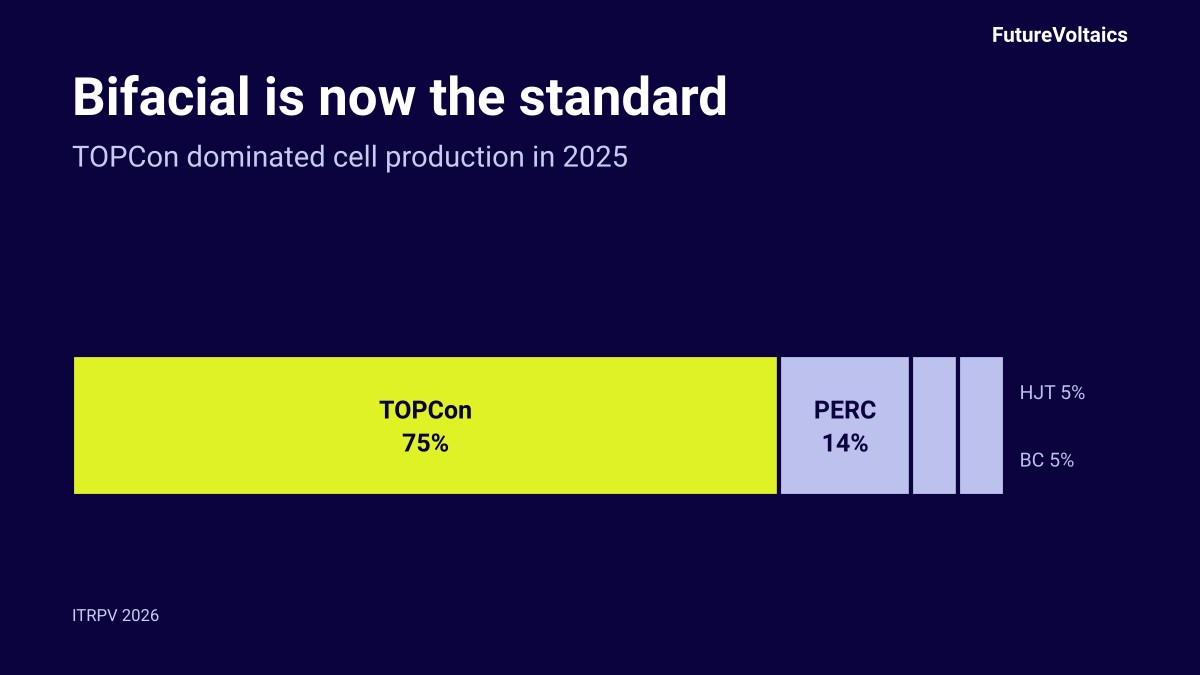
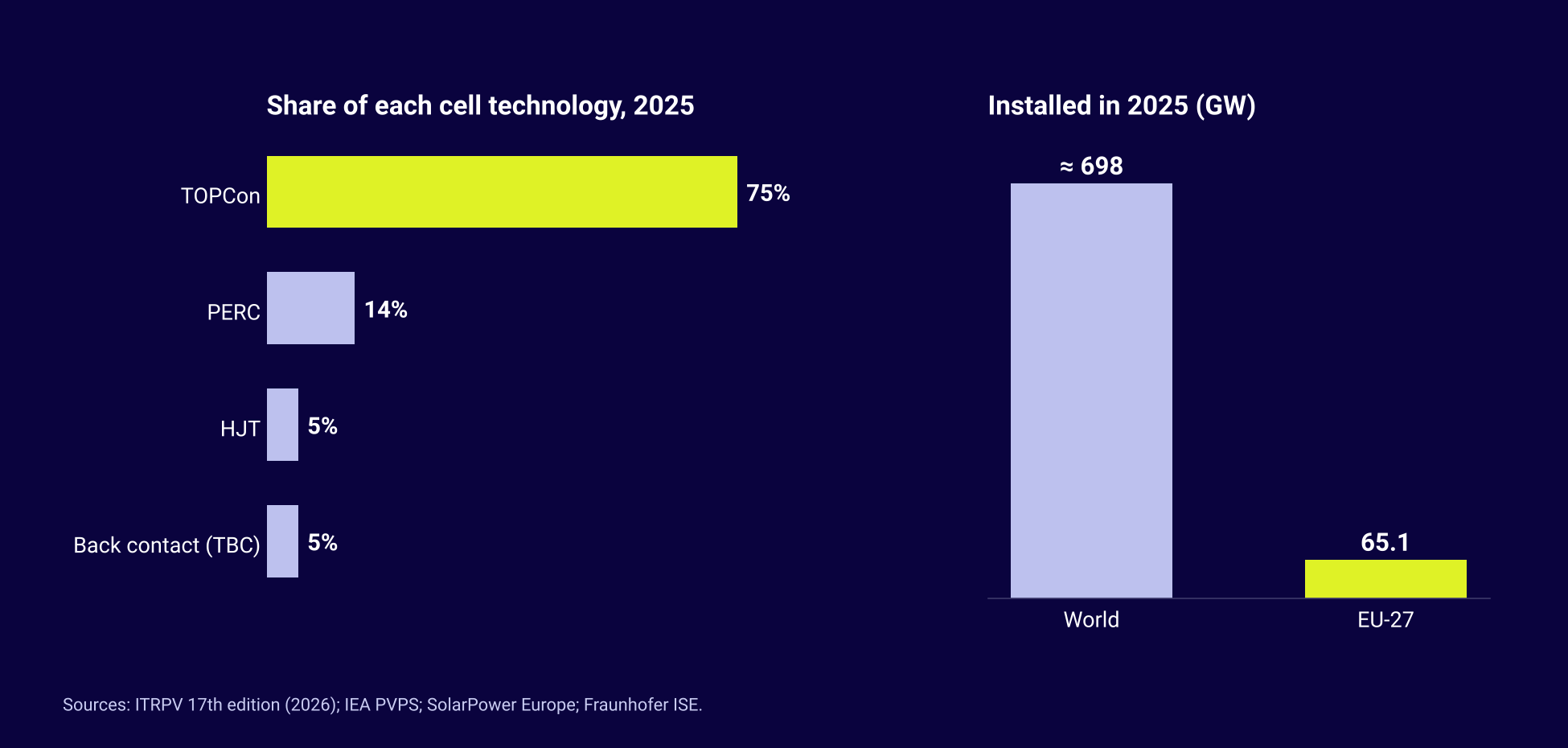
The world installed between 664 and 698 GW of solar PV in 2025, depending on the source, and the European Union 65.1 GW. Almost everything manufactured today is bifacial: ITRPV estimates that around 90% of cells are bifacial, heading for 95%. The dominant technology is TOPCon, with about 75% of cell production in 2025.
How much is being installed
| 2025 | Cumulative, end of 2025 | |
|---|---|---|
| World | 664 GW (SolarPower Europe) · ≈ 698 GW (IEA PVPS) | ≈ 2,974 GW (IEA PVPS) |
| European Union (EU-27) | 65.1 GW | 309.9 GW |
China installed 382 GW, 57% of the world total. As a single market the EU would rank second, although in 2025 it installed slightly less than in 2024 (65.6 GW). Europe accounts for 17% of the world’s cumulative PV capacity.
The two global figures for 2025 differ because each organisation uses its own method; either way, 2025 was a new record.
Which cell technologies are being made
| Technology | Share in 2025 | What it is |
|---|---|---|
| TOPCon | ≈ 75% | n-type silicon cell with a passivated contact. The new industry standard. |
| PERC | ≈ 14% | The dominant technology until 2023, now being phased out. |
| HJT (heterojunction) | ≈ 5% | Amorphous silicon layers on crystalline silicon. The most bifacial. |
| Back contact (BC) | ≈ 5% | All contacts on the rear; higher front efficiency, lower bifaciality. |
TOPCon overtook PERC in 2024 and dominated production in 2025. For the next decade, ITRPV expects TOPCon to stay in the lead, back-contact cells to reach 28% and silicon tandem cells to reach around 17% by 2036.
Bifacial is no longer a premium option
A bifacial cell captures light on both faces. A few years ago it was a special product; today it is the norm. ITRPV estimates that around 90% of cells are bifacial and that the figure will rise to 95%. According to its 2026 edition, the price premium for bifacial and n-type modules has practically disappeared.
With that share, we estimate that around 600 GW of the capacity installed worldwide in 2025 was bifacial.
Not every technology makes the same use of the rear face. Bifaciality is highest in HJT, slightly lower in TOPCon, and lower in PERC and back-contact cells.
What about Europe?
There are no public statistics on technology share for Europe alone, but where the modules come from explains it: in 2025 around 96% of modules and their components were made in Asia, and the EU has less than 5 GW a year of cell manufacturing capacity. Europe therefore installs essentially the same technologies as the rest of the world: bifacial TOPCon modules.
If the bifacial share is the same, we estimate that more than 55 GW of the 65.1 GW installed in the EU in 2025 was bifacial.
Why it matters to us
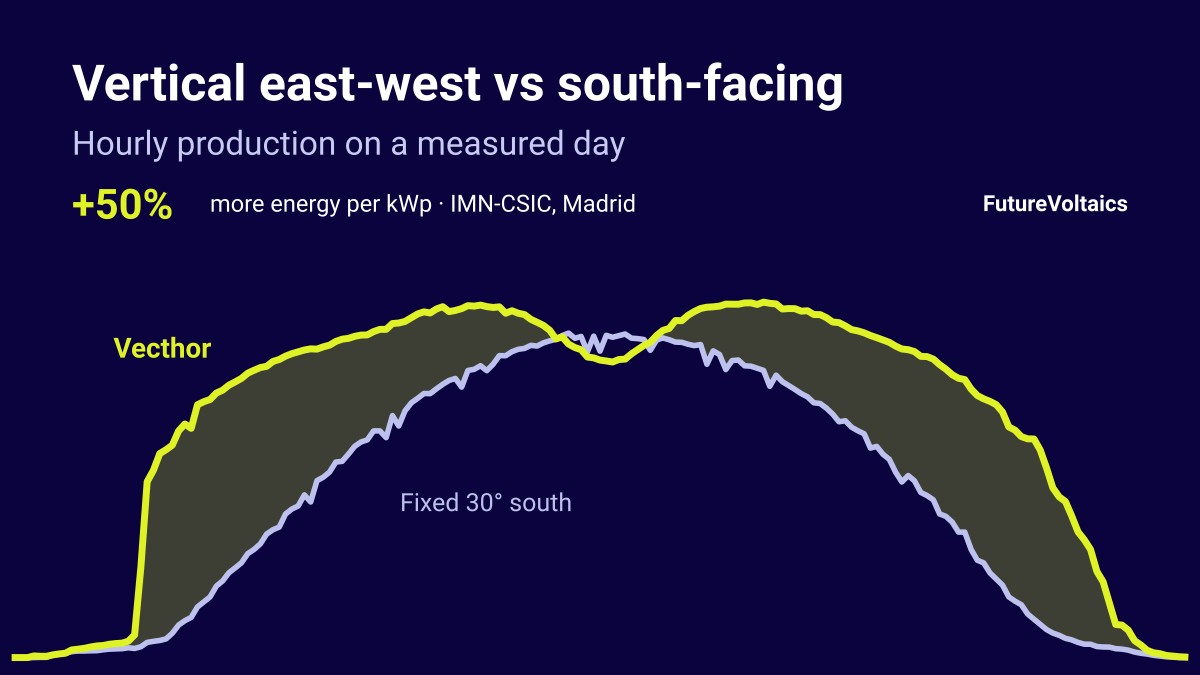
In a conventional south-facing tilted installation, the rear face of a bifacial panel adds a modest extra. In a vertical panel facing east and west, like Vecthor, both faces work at full output: one in the morning and the other in the afternoon. There, bifaciality stops being an extra and determines half of the production.
Bifacial modules being the standard today, with no price premium, is what makes vertical PV competitive. We explain it in How Vecthor works and in our post on hourly production.
FAQ
What share of solar panels are bifacial? ITRPV estimates that around 90% of cells manufactured are bifacial, and expects this to reach 95% over the next decade.
Which cell technology is most widely used? TOPCon, with about 75% of silicon cell production in 2025. PERC, the previous one, fell to 14%.
How much solar was installed in 2025? Between 664 and 698 GW worldwide, depending on the source, and 65.1 GW in the European Union.
Which technology is best for a vertical panel? The one with the highest bifaciality, because both faces produce. HJT is the most bifacial, followed by TOPCon; back-contact cells less so.