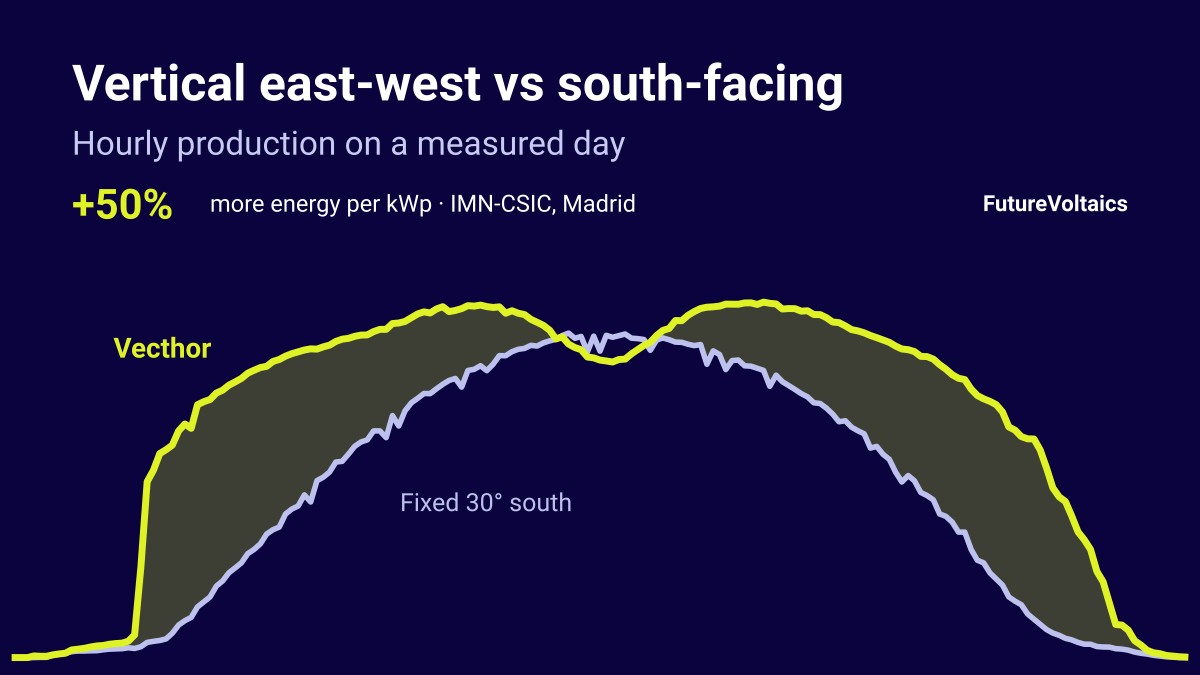
Short answer. A south-facing tilted panel concentrates its output around midday. A vertical bifacial panel facing east and west, with reflectors, achieves two things: it produces more energy per panel and spreads its output across the morning and the afternoon, giving a generation curve far better matched to consumption and to energy prices. On 2 July 2026, in Madrid, our Vecthor system produced 10.97 kWh per installed kWp, against 7.30 for a fixed panel tilted 30° to the south: 50% more.
Two ways of facing the sun
Traditionally, panels face south at the tilt that maximises production over the year. In Spain that optimum tilt is around 30-35°, slightly below the latitude, because most of the energy arrives in the months when the sun is high. That geometry maximises the light on the panel when the sun is high, around solar noon, and gives a bell-shaped curve.
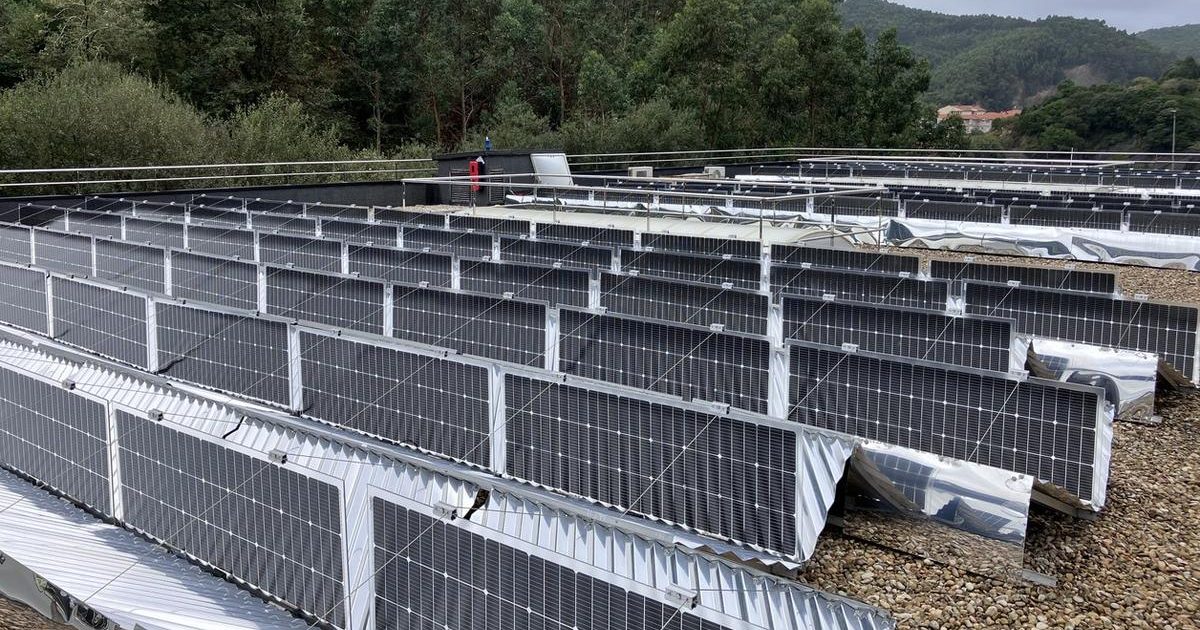
Thanks to the rapid development of bifacial solar cells, now the mainstream technology, a single panel can face east and west at the same time: it only needs to be mounted vertically. In the morning the sun hits the east face almost head-on and, in the afternoon, the west face. At midday the sun is high, its light grazes the panel and output drops.
Vecthor adds two fixed reflectors on either side of the panel. When the sun is low or at mid-height, the reflectors send light back to the panel and raise its output. When the sun is very high, part of that light goes back to the sky. How Vecthor works explains the geometry in more detail.
What we measured, and where
The data in this article are real measurements from the IMN-CSIC test field in Madrid. Every five minutes we compared the power of a Vecthor unit with that of a conventional fixed panel facing south and tilted 30°, at the same site and on the same day. Both are expressed in kW per installed kWp, so the comparison does not depend on system size.
2 July was a clear summer day, when the difference in shape between the two curves is easiest to see.
The curve, hour by hour
| Time (CEST) | Vecthor (kW/kWp) | Fixed 30° south (kW/kWp) |
|---|---|---|
| 9:00 | 0.73 | 0.16 |
| 10:00 | 0.85 | 0.37 |
| 12:00 | 0.99 | 0.76 |
| 14:00 | 0.88 | 0.92 |
| 16:00 | 1.01 | 0.85 |
| 18:00 | 0.91 | 0.58 |
| 19:00 | 0.80 | 0.36 |
| 20:00 | 0.63 | 0.11 |
Three things stand out:
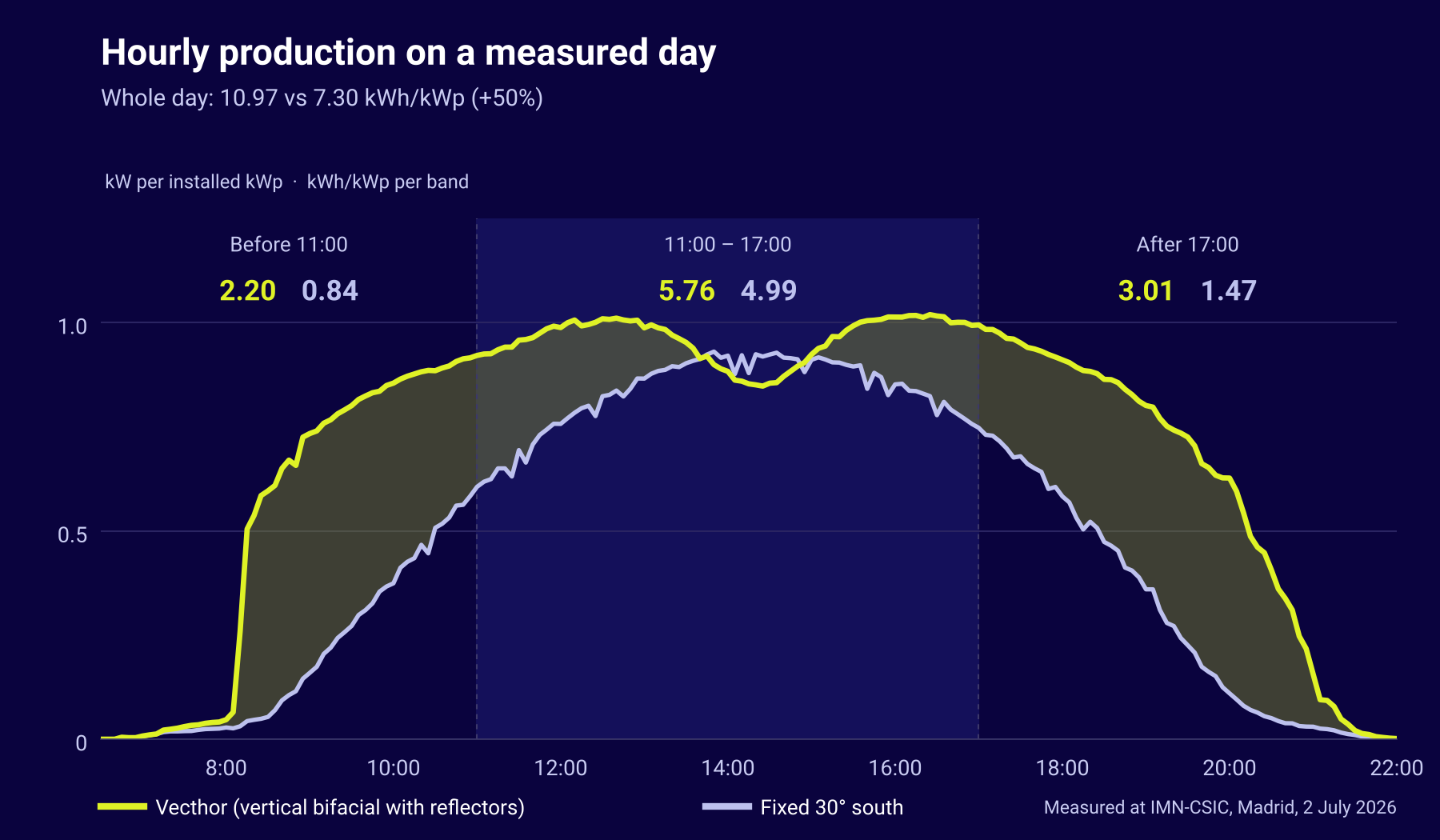
- Morning. At 9:00 the conventional panel has barely started (0.16 kW/kWp), while Vecthor is already at 73% of its rated power.
- Midday. Around 14:00 the south-facing panel produces slightly more than Vecthor. It is the only time of day it wins, and by a small margin.
- Afternoon. At 19:00 Vecthor is still at 80% and the conventional panel has fallen to 36%. At 20:00, 0.63 against 0.11.
Where the energy is gained
Adding up the energy by time band:
| Time band | Vecthor (kWh/kWp) | Fixed 30° south (kWh/kWp) | Vecthor advantage |
|---|---|---|---|
| Before 11:00 | 2.20 | 0.84 | +163% |
| 11:00 to 17:00 | 5.76 | 4.99 | +15% |
| After 17:00 | 3.01 | 1.47 | +104% |
| Whole day | 10.97 | 7.30 | +50% |
Almost all the advantage comes from both ends of the day: 1.36 kWh/kWp more before 11:00 and 1.54 more after 17:00. In the central hours the difference is smaller (0.77 kWh/kWp).
The result repeats on other days. On 17 June 2026, at the same field, Vecthor produced 10.56 kWh/kWp and the conventional panel 7.11: 49% more.
Why the time of production matters
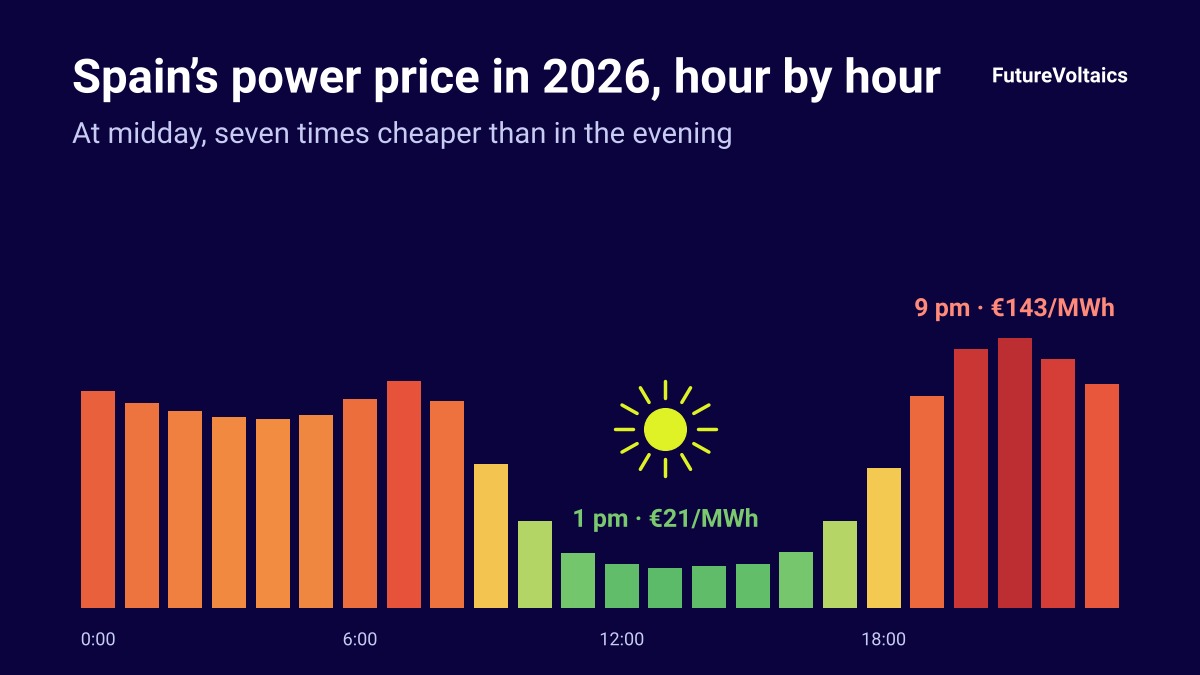
Energy is not worth the same at every hour. In the Spanish electricity market, the abundance of conventional solar pushes prices down in the central hours of sunny days, and prices rise early and late. Producing more when energy is worth more raises revenue by more than the kWh figure suggests. We explain this in The value of solar energy and timing and The duck curve.
For self-consumption, the advantage is similar. A plant working from 8:00 to 20:00 uses more of its own energy and buys less from the grid if production also covers the morning and the afternoon.
What other measurements show
Madrid is not an isolated case. In our ongoing measurement campaigns, Vecthor produces more energy per kWp than the fixed reference system in three different climates:
- Lemoiz (Biscay), wastewater treatment plant: +58.5% energy per kWp against a fixed system tilted 10° south, cumulative data to 30 September 2026.
- Madrid, IMN-CSIC: +43.3% against a fixed system tilted 30° south, over the measurement campaign.
- Konstanz (Germany), ISC Konstanz: +40.6% against a fixed system tilted 20° south.
Campaign percentages are lower than on a clear summer day because they include cloudy days and seasons with a lower sun.
When each configuration makes sense
- Fixed, tilted south: when consumption is concentrated at midday.
- Vertical bifacial with reflectors: when energy per installed kWp matters, when consumption is spread over the working day, or when energy is sold at high-price hours. To compare them by roof area, see kWp or m².
To estimate the result at your site, use the income calculator.
FAQ
Does a vertical panel produce less at midday?
Slightly, but the reflectors largely make up for it. With the sun high, direct light grazes the panel, and the reflectors send part of it back. In our 2 July measurement, at 14:00, the south-facing panel produced 0.92 kW/kWp and Vecthor 0.88.
Where does the 50% come from?
From the morning and the afternoon: before 11:00 and after 17:00, Vecthor produced 5.21 kWh/kWp against 2.31 for the conventional system.
Is it the same all year round?
No. The advantage is largest on long, clear days. Over full campaigns we have measured 40% to 58% more energy per kWp, depending on the site.
What do the reflectors do?
They send light back to the panel when the sun is low or at mid-height. They are fixed: no motors and no moving parts.
Is it suitable for industrial self-consumption?
Yes, especially when consumption starts early or runs into the afternoon, because production covers more hours of the working day.