By José María Pimienta
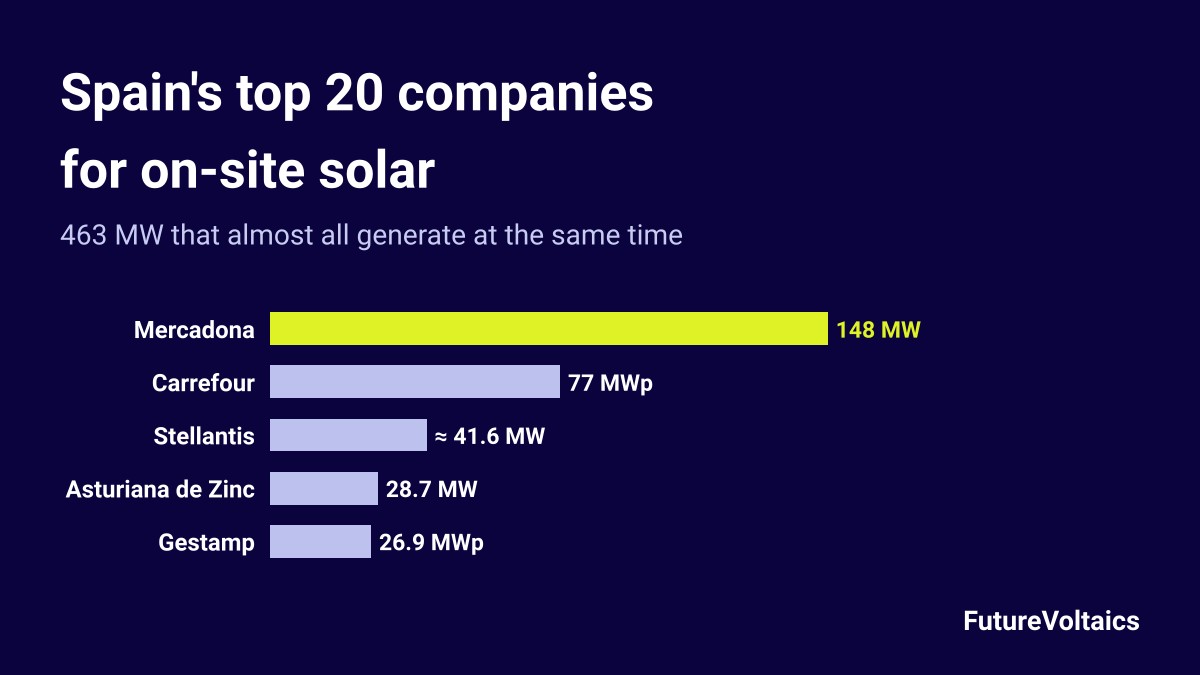
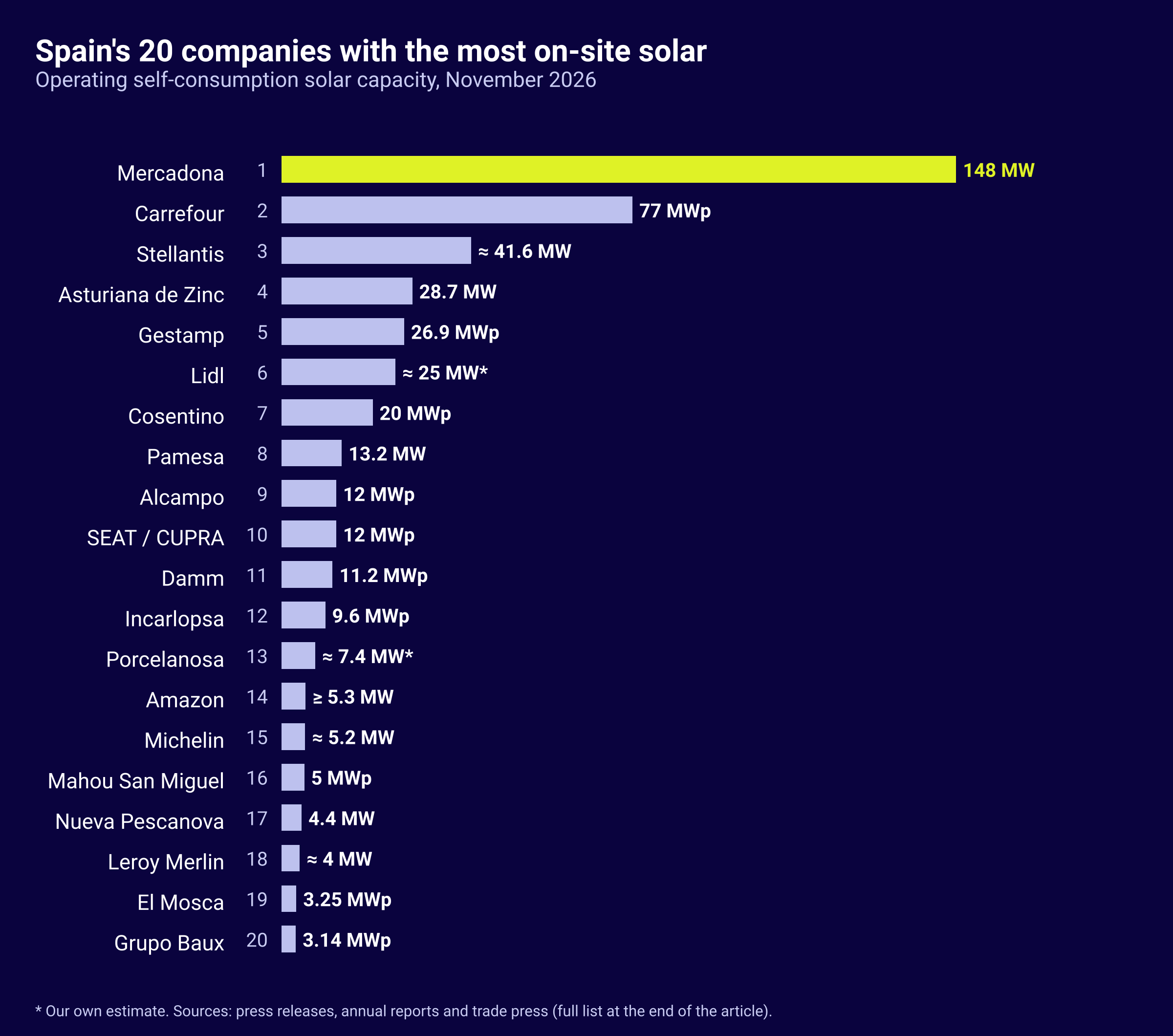
Which companies have the most solar panels generating for their own use across their shops, warehouses and factories? We went through press releases, annual reports and the trade press, and counted only capacity that is already up and running. Together, the top 20 add up to around 463 MW. And almost all of it generates at the same time of day.
How we counted
To keep the ranking like-for-like, we followed four rules:
- Self-consumption at the company’s own sites in Spain: rooftops, carports or ground-mounted next to the plant.
- On-site PPAs count (where a third party installs and operates the panels at the customer’s site and sells it the energy). We flag them.
- The whole group counts: if a company has panels on 600 shops, all 600 are included.
- Operating capacity only. Announced projects we haven’t been able to confirm are listed separately.
There is no public register showing who owns each installation (UNEF and Red Eléctrica only publish aggregate figures), so this ranking is an approximation based on public data. If you work for one of these companies and have a more recent figure, get in touch and we’ll update it.
The top 20
| # | Company | Capacity | Where |
|---|---|---|---|
| 1 | Mercadona | 148 MW | Almost 600 supermarkets and 8 logistics hubs |
| 2 | Carrefour | 77 MWp | 177 hypermarkets |
| 3 | Stellantis | ≈ 41.6 MW | Vigo, Zaragoza and Madrid plants (PPA at Vigo and Zaragoza) |
| 4 | Asturiana de Zinc | 28.7 MW | San Juan de Nieva (Asturias), on former waste ponds |
| 5 | Gestamp | 26.9 MWp | 22 plants across Iberia (PPA) |
| 6 | Lidl | ≈ 25 MW* | 281 shops and 9 logistics platforms |
| 7 | Cosentino | 20 MWp | Cantoria industrial park (Almería) |
| 8 | Pamesa | 13.2 MW | Onda (Castellón) |
| 9 | Alcampo | 12 MWp | 20 sites (Helexia) |
| 10 | SEAT / CUPRA | 12 MWp | Martorell |
| 11 | Damm | 11.2 MWp | El Prat, Murcia, Málaga, ZAL Barcelona and La Moravia |
| 12 | Incarlopsa | 9.6 MWp | 4 sites in Toledo and Cuenca |
| 13 | Porcelanosa | ≈ 7.4 MW* | Group shops and sites |
| 14 | Amazon | ≥ 5.3 MW | Dos Hermanas (Seville) and 29 other rooftops |
| 15 | Michelin | ≈ 5.2 MW | Almería and Valladolid |
| 16 | Mahou San Miguel | 5 MWp | Alovera (Guadalajara) |
| 17 | Nueva Pescanova | 4.4 MW | 5 sites in Galicia |
| 18 | Leroy Merlin | ≈ 4 MW | 10 shops |
| 19 | El Mosca | 3.25 MWp | Alhama de Murcia |
| 20 | Grupo Baux | 3.14 MWp | Segorbe (Castellón) |
* Our own estimate: Lidl doesn’t publish its capacity (we worked it out from the 32.2 GWh it generated in 2025), and for Porcelanosa we left out the Vila-real plant, which is still under construction.
The context: 9.3 GW of self-consumption in Spain
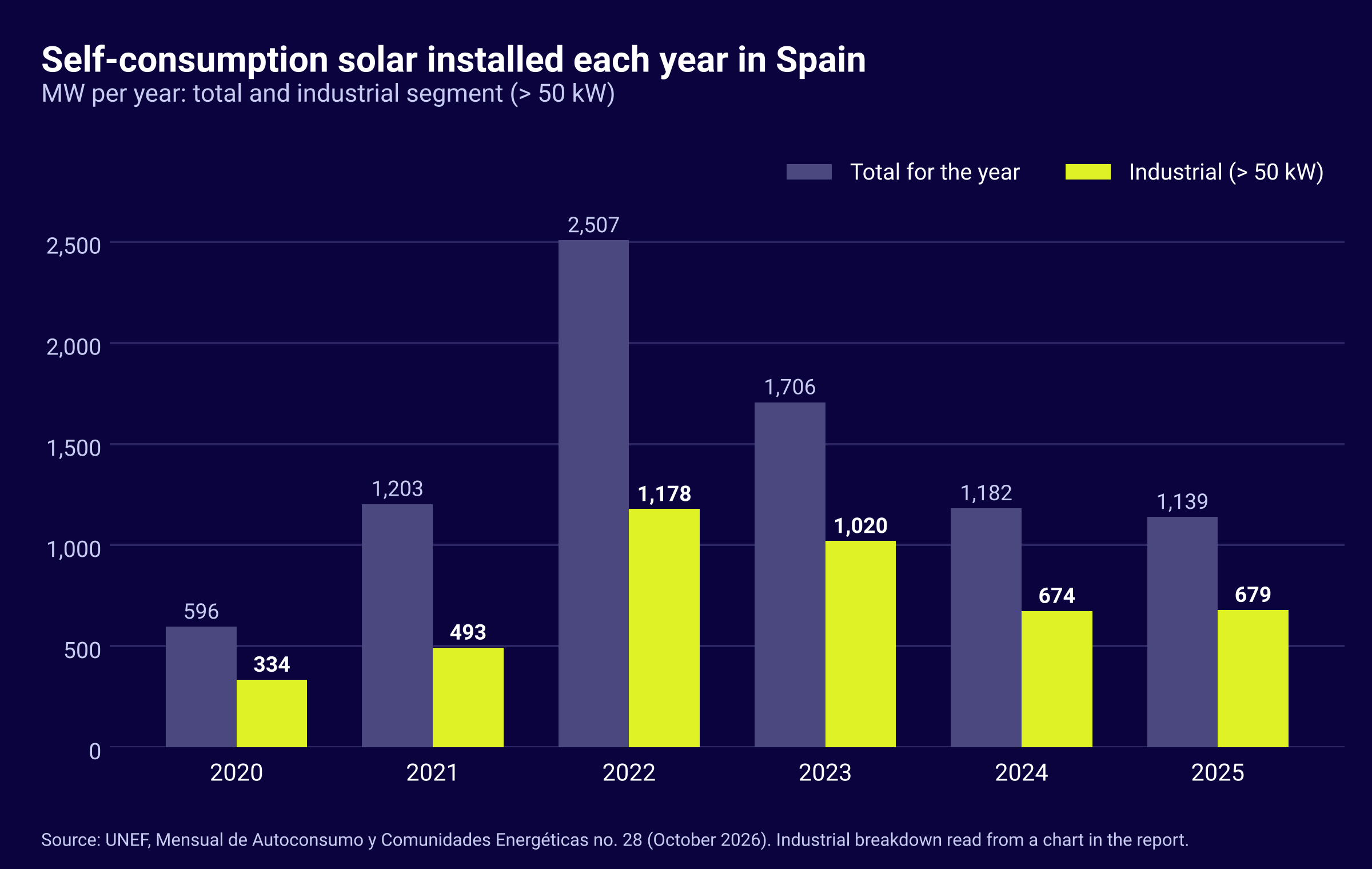
According to UNEF, Spain ended 2025 with 9,276 MW of cumulative self-consumption solar. The industrial segment (installations over 50 kW) carries the most weight: it has added around 4,400 MW since 2020.
| Year | Industrial (> 50 kW) | Total installed that year | Cumulative |
|---|---|---|---|
| 2020 | 334 MW | 596 MW | 1,539 MW |
| 2021 | 493 MW | 1,203 MW | 2,742 MW |
| 2022 | 1,178 MW | 2,507 MW | 5,249 MW |
| 2023 | 1,020 MW | 1,706 MW | 6,955 MW |
| 2024 | 674 MW | 1,182 MW | 8,137 MW |
| 2025 | 679 MW | 1,139 MW | 9,276 MW |
Source: UNEF, Mensual de Autoconsumo y Comunidades Energéticas no. 28 (October 2026). The industrial breakdown is read from a chart in the report.
Three takeaways:
- Twenty companies, 5% of the total. The top 20’s 463 MW is around 5% of all self-consumption in Spain and just over 10% of the industrial capacity installed since 2020.
- Industrial self-consumption has settled at half its peak. In 2022, the year of the energy price crisis, 1,178 MW of industrial capacity went in. Since 2024 the pace has been around 680 MW a year.
- 2026 is on a similar track. According to Red Eléctrica, 736 MW of self-consumption of all sizes was connected from January to August, peaking at 177 MW in June.
What the ranking tells us
Retail leads the way. Supermarkets take the top two spots, and Lidl and Alcampo also make the top 10. They have thousands of square metres of flat roof, year-round electricity demand (refrigeration, lighting, air conditioning) and lots of near-identical sites, so a solution that works at one can be rolled out across hundreds.
Heavy industry goes big on single sites. Asturiana de Zinc, Cosentino and Pamesa each have 13 to 29 MW in one location. Spain’s largest single self-consumption plant, at Asturiana de Zinc, isn’t even on a roof: it sits on former waste ponds.
Carmakers got there first. SEAT switched on its 53,000-panel plant in Martorell back in 2013, when self-consumption was still a rarity. Today Stellantis, Gestamp, Michelin and SEAT itself add up to more than 85 MW.
On-site PPAs are on the rise. Stellantis, Gestamp and Alcampo didn’t buy their panels: a third party installs and operates them and sells them the energy. It’s a way to get self-consumption without investing in the asset.
What’s coming
At least another 110 MW has been announced that we haven’t yet been able to confirm as operating. If it is, the ranking will change:
- Viscofan: 48 MWp at Cáseda (Navarre), with Acciona Energía. It would go straight in at number three.
- SEAT al Sol 2: another 21 MW at Martorell, El Prat and Barcelona.
- Cosentino: a 15 MWp second phase on its factory roofs.
- DuPont: 12.6 MWp at its Asturias site.
The one thing they all share: midday
These 463 MW, like most of Spain’s 9.3 GW of self-consumption, have one thing in common: almost all of it generates mainly between 11 am and 5 pm, because the panels face south and peak output coincides with the sun’s.
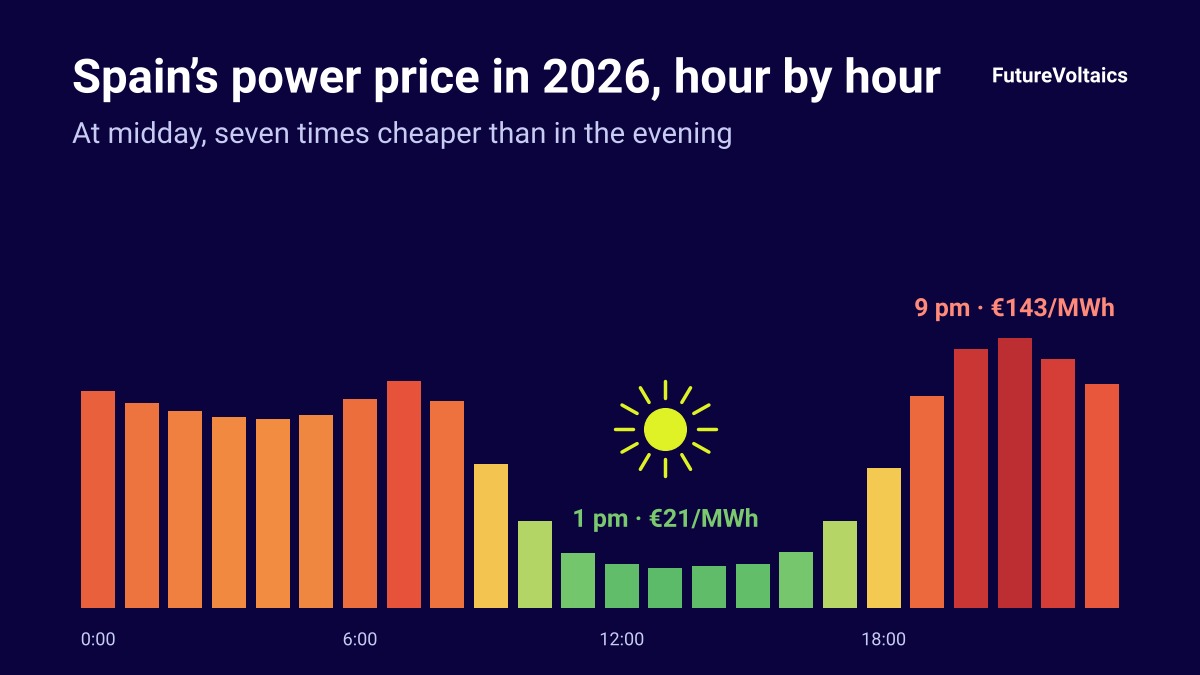
The catch is that the rest of the country’s solar is generating at the same time. On sunny days, market prices collapse: on 17 June 2026, Spain’s wholesale price fell to €9/MWh at 1 pm, against more than €150/MWh at 9 pm. For a business with self-consumption, each kWh generated at midday saves less than one generated at 9 am or 8 pm, when demand is still high and grid electricity costs more.
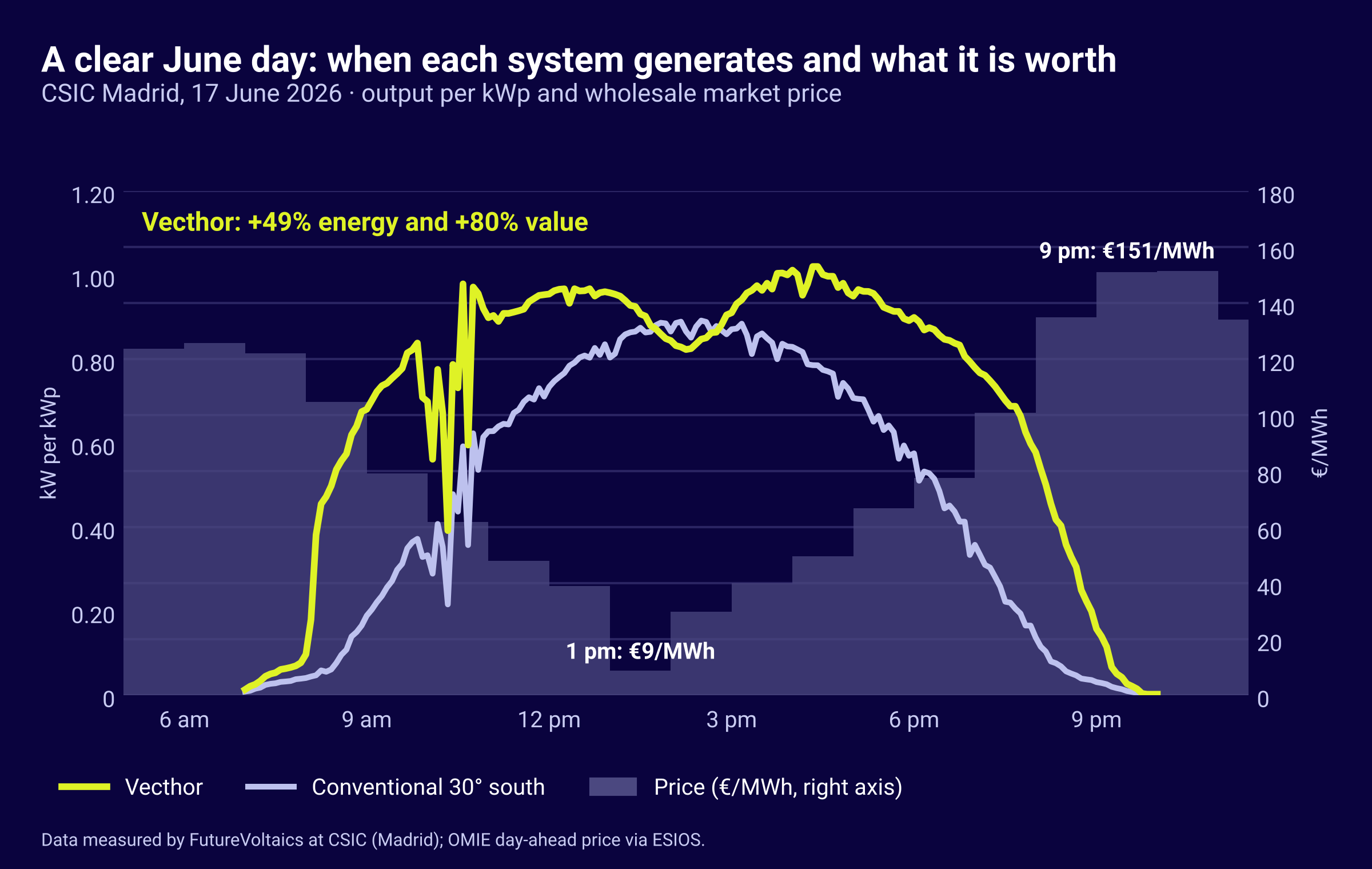
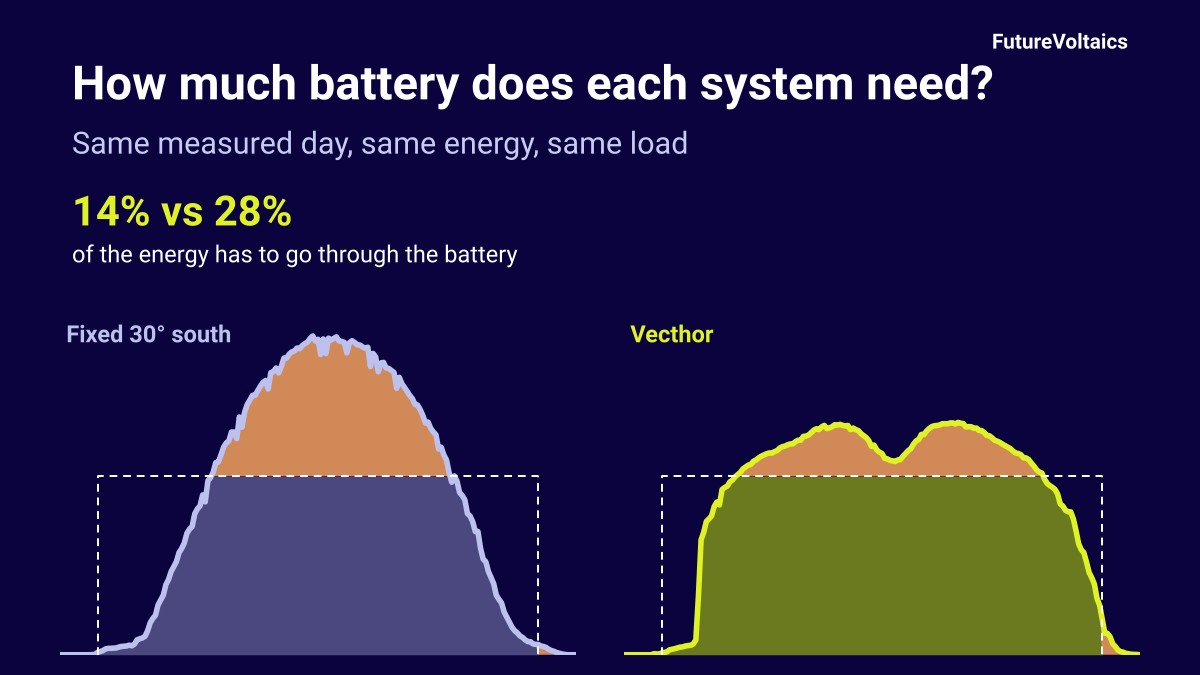
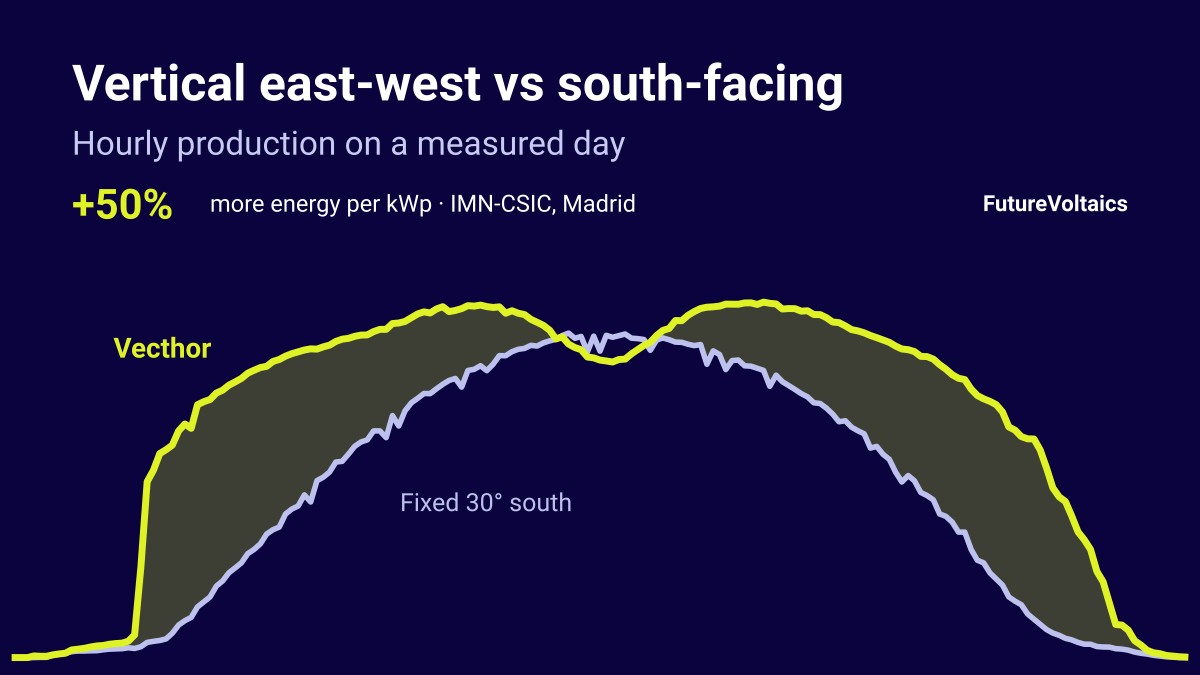
That’s why we designed Vecthor5 at FutureVoltaics to generate more at those other times: a vertical bifacial panel with reflectors that behaves like a tracker with no moving parts. On a clear summer day in Madrid (CSIC, 17 June 2026), it generated 49% more energy than a conventional installation, with a flat curve from 9 am to 8 pm, and that energy was worth 80% more at market prices. And as a lightweight kit that needs no building work, it suits flat roofs like those on many of these sites.
Generating more is good. Generating when energy is worth more is far better. More power when it matters.
Is your company missing?
This ranking is based on public data, so we’ve almost certainly missed someone. If your company has more self-consumption capacity than shown here, or a project already up and running, email us at info@futurevoltaics.com and we’ll include it in the next update.
Want to know how much more your roof could generate with Vecthor5 at the hours that cost you most? Email us at info@futurevoltaics.com.
Sources
- Mercadona: Vozpópuli (Memoria anual 2024), 12/3/2025
- Carrefour: Nota de prensa Carrefour, 15/7/2025
- Stellantis: Energías Renovables, 26/3/2025 · Telecinco, 22/1/2023
- Asturiana de Zinc (Glencore): Ecoticias, 15/7/2026
- Gestamp: Gestamp, 2022
- Lidl: Lidl, Informe de Sostenibilidad 2025 · Lidl, Proteger el clima
- Cosentino: Cosentino · Review Energy, 8/11/2022
- Pamesa: Alimarket, 10/7/2020
- Alcampo: Just Retail, 3/11/2026
- SEAT / CUPRA: Público, 11/11/2013 · Crónica Global, 12/10/2026
- Damm: Damm, 25/3/2024
- Incarlopsa: IPP Journal, 22/7/2022
- Porcelanosa: El Debate, 23/7/2026
- Amazon: Amazon, 30/11/2022
- Michelin: Energías Renovables, 6/11/2023 · Energías Renovables, 8/7/2010
- Mahou San Miguel: RRHH Press, 14/7/2022
- Nueva Pescanova: Interempresas, 16/4/2021
- Leroy Merlin: Energías Renovables, 3/4/2024
- El Mosca: Energética 21, 18/10/2019
- Grupo Baux: Energías Renovables, 29/6/2026