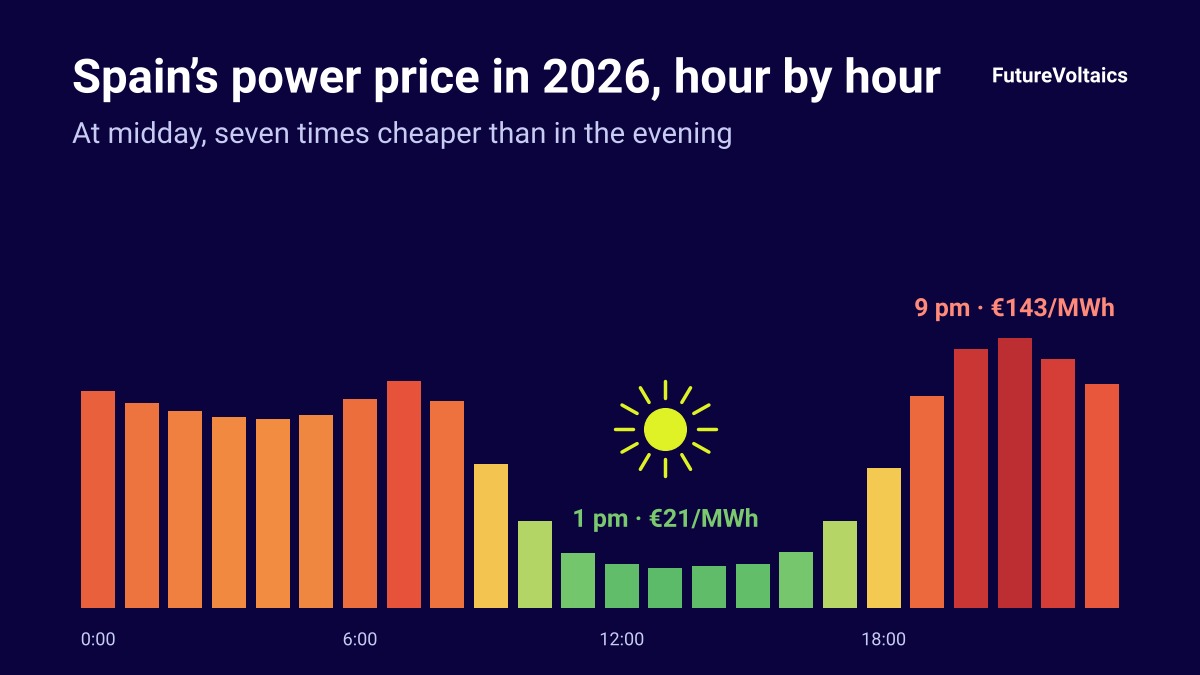
From January to October 2026, the average day-ahead price in Spain was €83.5/MWh. But hardly anyone pays or earns that price: at 13:00 the average was €21/MWh and at 21:00, €143/MWh. The same energy is worth seven times more depending on when it is produced or used.
The average hides what matters
The day-ahead market sets a different price for every hour of the next day. That price depends on which technologies are available at each moment: when there is surplus cheap energy, the price falls; when more expensive plants are needed, it rises.
That is why the annual average says little. For a consumer or a producer, what counts is the price in the hours when they consume or produce.
Four bands, four prices
We split the daylight hours into four equal four-hour bands:
| Band | Average price 2026 (Jan-Oct) | vs average |
|---|---|---|
| 06-10 h | €104.2/MWh | +25% |
| 10-14 h | €29.6/MWh | −65% |
| 14-18 h | €30.2/MWh | −64% |
| 18-22 h | €116.6/MWh | +40% |
The eight central hours of the day are worth less than a third of the early morning and the evening.
Month by month
| Month | 06-10 h | 10-14 h | 14-18 h | 18-22 h | Monthly average |
|---|---|---|---|---|---|
| Jan | 75.1 | 60.5 | 66.1 | 98.9 | 71.7 |
| Feb | 19.9 | 0.6 | 2.0 | 54.4 | 16.4 |
| Mar | 46.3 | 12.6 | 15.6 | 82.1 | 41.8 |
| Apr | 61.4 | 4.8 | 0.6 | 59.2 | 42.4 |
| May | 70.2 | 3.7 | 1.6 | 70.7 | 54.2 |
| Jun | 84.1 | 16.6 | 16.1 | 82.9 | 69.6 |
| Jul | 124.7 | 41.3 | 39.0 | 122.8 | 104.7 |
| Aug | 155.6 | 26.0 | 26.8 | 154.4 | 118.2 |
| Sep | 189.9 | 45.8 | 45.1 | 201.1 | 143.3 |
| Oct | 207.2 | 81.0 | 85.6 | 233.6 | 166.6 |
Prices in €/MWh.
Three phases:
- Winter (January). Little difference between bands: the sun produces little and the midday price is close to the rest of the day.
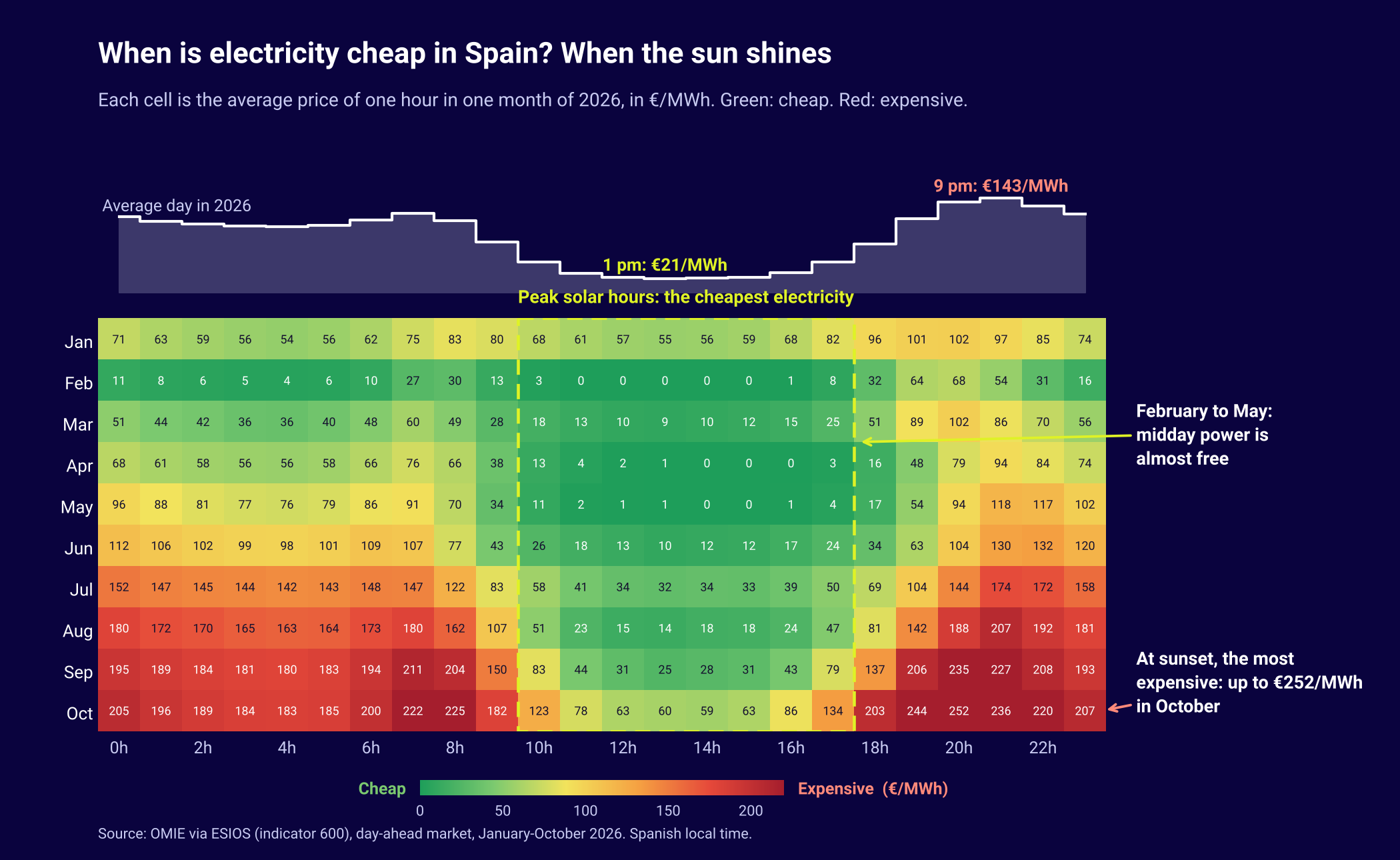
- Spring (February to June). Plenty of solar, plenty of wind and lower demand: the central hours stayed close to zero for months. In April, the 14-18 h band averaged €0.6/MWh.
- Second half of the year. Prices rise sharply, but midday stays far below: in October, €81/MWh between 10 and 14 h against €234/MWh between 18 and 22 h.
Weekdays and weekends
The type of day matters too. In 2025, the 13:00 price averaged €34/MWh on weekdays and €13/MWh at weekends, when demand is lower. At 21:00, €117/MWh and €93/MWh.
Hours at zero or negative prices
Up to 5 November, 941 hours of 2026 had an average price at or below zero. Almost all fell between 10 and 18 h, and most between February and May. In those hours, a plant selling its energy on the market earns nothing.
What it means for producers and consumers
- For those selling energy: producing at midday is worth less and less. What adds value is producing early in the morning and late in the afternoon.
- For consumers: shifting consumption to the central hours lowers the bill if the contract follows the hourly price.
- For self-consumption: own energy that replaces expensive evening purchases is worth far more than surplus at midday.
In the next posts we look at how this pattern has evolved since 2023, how Spain compares with Europe, and what it means for a Vecthor installation.
FAQ
How much did electricity cost on the wholesale market in 2026? On average, €83.5/MWh between January and October, with very different months: €16.4/MWh in February and €166.6/MWh in October.
Which is the cheapest hour? 13:00, averaging €21/MWh in 2026. The most expensive is 21:00, at €143/MWh.
Why is electricity so cheap at midday? Because it coincides with peak solar output. When there is surplus energy with no fuel cost, the price of that hour falls, sometimes to zero.
How many hours have had zero or negative prices? 941 up to 5 November 2026, mostly between 10 and 18 h and between February and May.