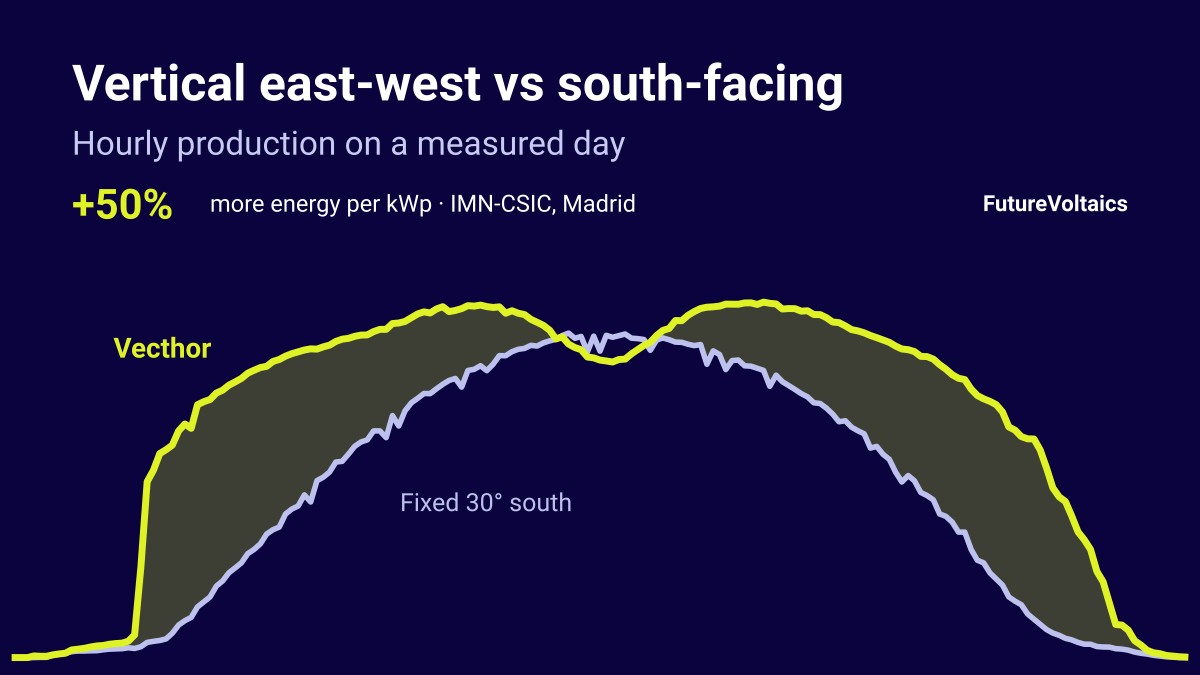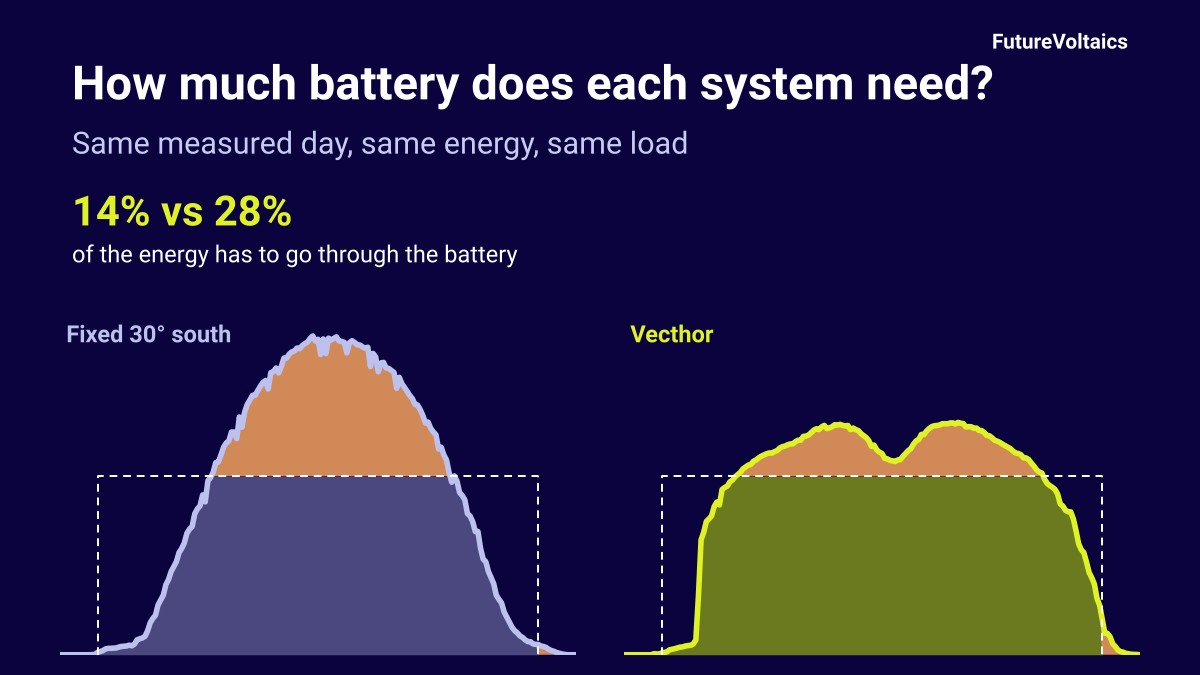
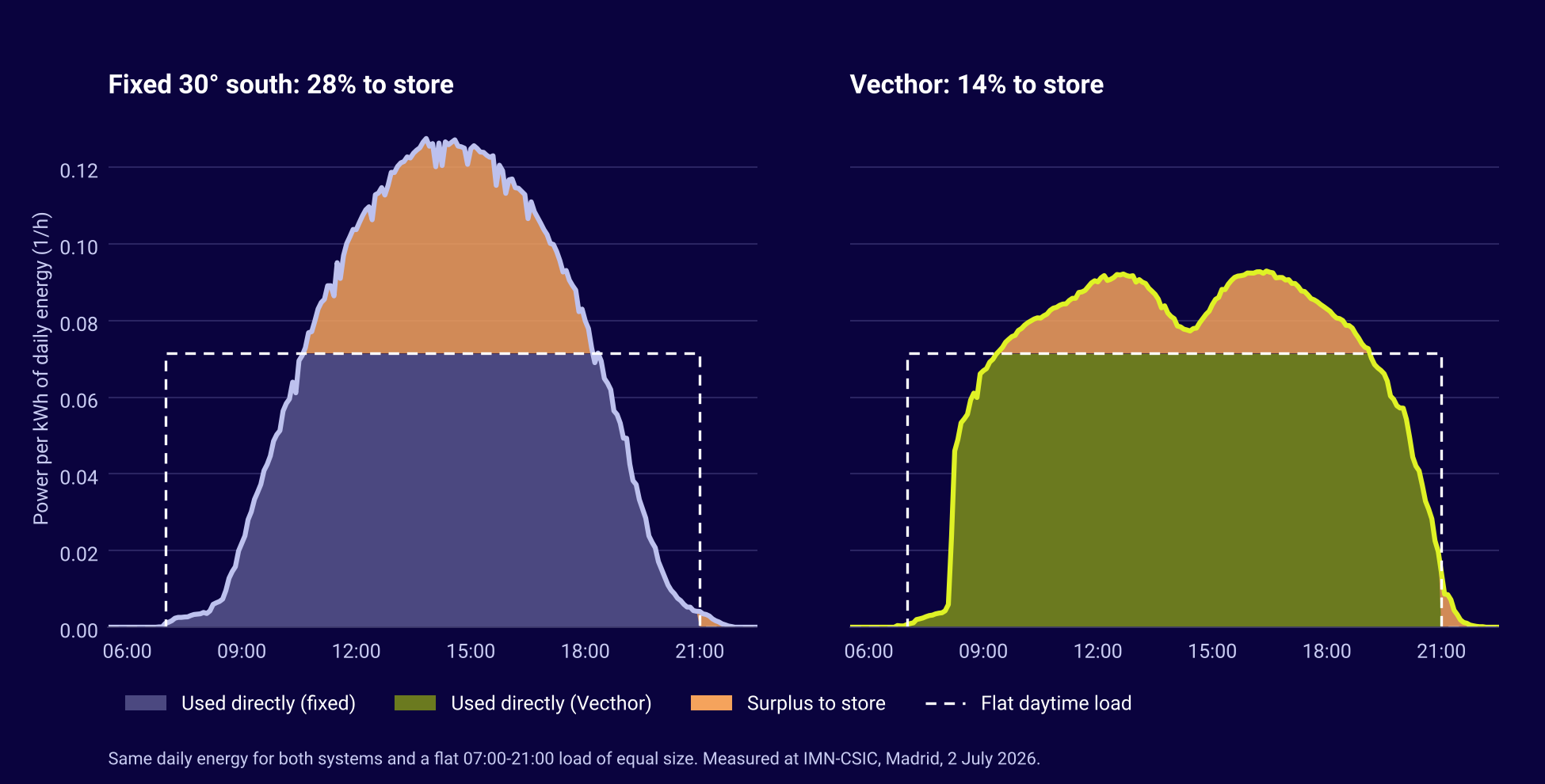
A battery is only needed for the energy produced when it is not being used. With the same daily energy and a flat load from 07:00 to 21:00, a fixed panel tilted 30° south has to store 28% of its output in a battery. Vecthor only 14%: half. These are measured data from Madrid, 2 July 2026.
The problem with a bell-shaped curve
A south-facing tilted panel produces a lot at midday and little in the morning and afternoon. If consumption is spread over the working day, there is surplus energy at midday and a shortfall early and late. To use that surplus, it has to be stored in a battery and used later.
The peakier the curve, the more energy has to be shifted in time and the larger the battery has to be. In our previous post we saw that Vecthor spreads its output across the morning and the afternoon. Here we measure what that means for storage.
The exercise
We took the two curves measured on 2 July at the IMN-CSIC test field (Madrid): Vecthor and a fixed panel facing south and tilted 30°. To compare them on equal terms:
- We scaled each curve so that both produce the same energy over the day.
- We set them against a flat load from 07:00 to 21:00 that uses exactly that same energy.
- Whatever each system produces above the load is surplus: energy that has to go through a battery to be used.
The result
| Fixed 30° south | Vecthor | |
|---|---|---|
| Energy used directly | 72% | 86% |
| Energy that has to be stored | 28% | 14% |
| Battery needed per 1,000 kWh of daily load | about 280 kWh | about 130 kWh |
With the same energy and the same load, Vecthor needs half the battery. The fixed panel concentrates its surplus in the central hours; Vecthor barely exceeds the load and covers it from early morning to the afternoon.
And fewer panels too
The exercise equalises the daily energy, but in reality Vecthor produces more per installed kWp. That day, producing 1,000 kWh took about 137 kWp of fixed 30° south panels and about 91 kWp of Vecthor. Less installed capacity and half the battery for the same load.
Not just Madrid
The same exercise with data measured by ISC Konstanz (Germany) on 9 July 2026, against a fixed system tilted 20° south, gives a very similar result: 24% of the conventional system’s energy has to go through the battery, against 12% for Vecthor.
What it means for a project
- Smaller batteries and less investment for the same self-consumption, or more self-consumption with the same battery.
- Lower losses. Every kWh that goes through a battery loses part of itself on charge and discharge; storing half the energy means losing less.
- Every kWh of battery works harder, because it can be sized more tightly.
This is a clear summer day and a flat load, a simple case to show the effect. Each project is sized with its real load curve and a full year of data. To get started, use the income calculator or contact us.
FAQ
Why does Vecthor need less battery? Because it produces more in the morning and afternoon and has a lower midday peak. Its curve is closer to the load, so there is less surplus to shift in time.
What load was assumed? A flat load from 07:00 to 21:00 that uses the same energy over the day as the panels produce. It is a simple case; with each customer’s real load curve the result changes.
Does the result hold all year round? It is a clear summer day in Madrid. In Konstanz, in July, the result was very similar (12% against 24%). Batteries are sized with a full year of data.
How much battery would 1,000 kWh a day need? In this case, about 280 kWh with fixed 30° south panels and about 130 kWh with Vecthor.