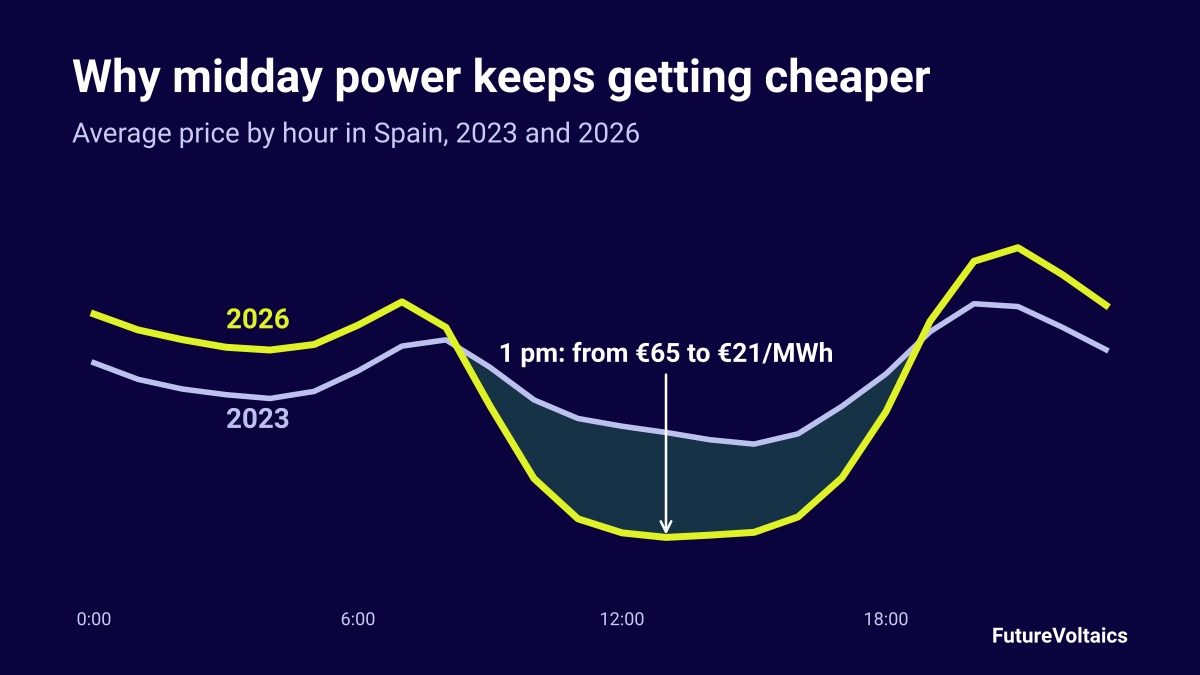
Since 2023, the average day-ahead price at 13:00 has fallen from €65 to €21/MWh, while the 21:00 price has risen from €118 to €143/MWh. Hours at zero or negative prices have gone from 108 in 2023 to 941 so far in 2026. The cause is solar PV itself: the more solar energy enters at the same hour, the lower that hour’s price.
Four years of prices in one chart
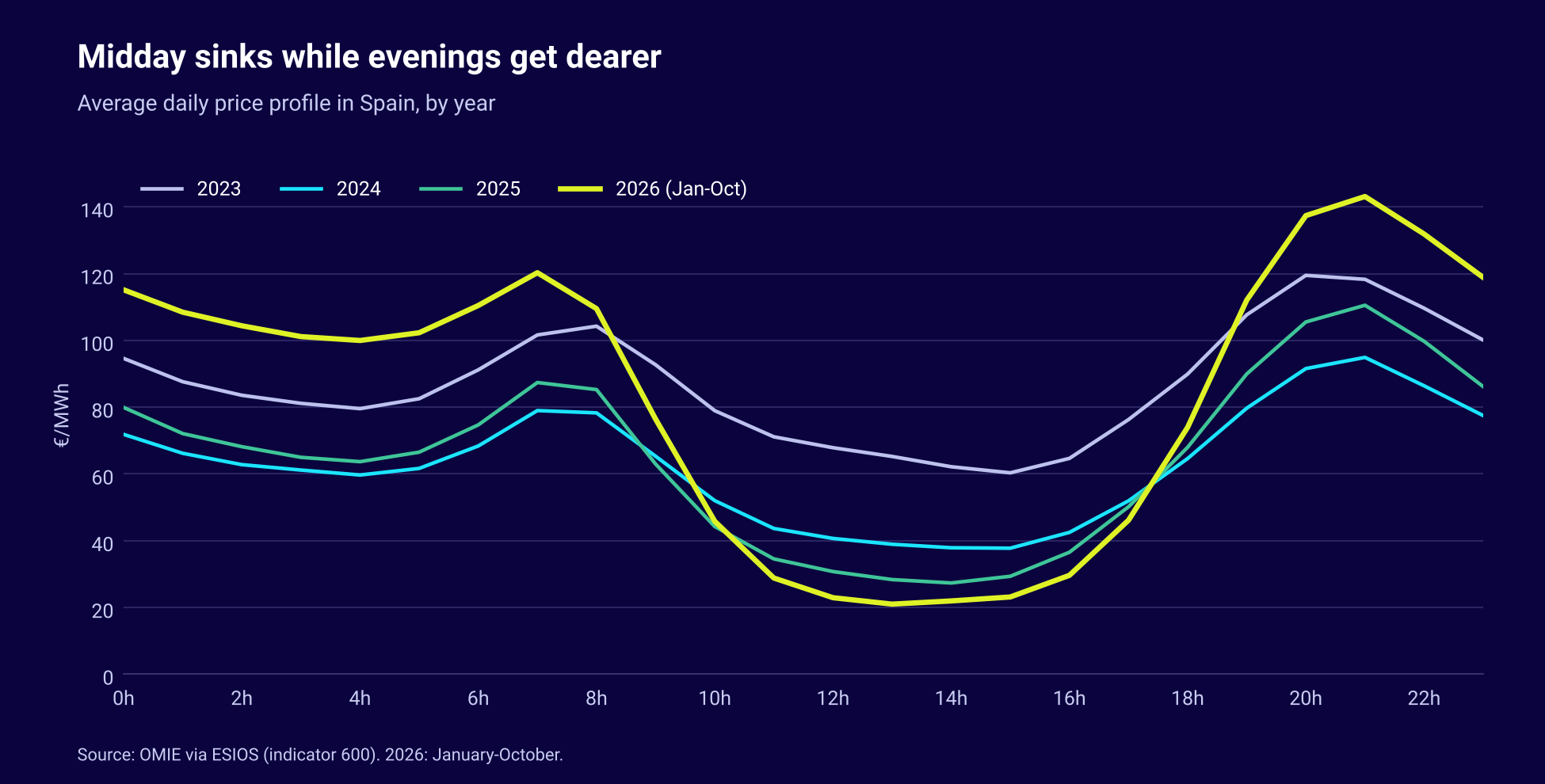
Each line is the average price for each hour of the day over a year. The shape has become sharper: an ever-deeper “U”, with the bottom at midday and the ends rising.
The data
| Year | Average | 06-10 h | 10-14 h | 14-18 h | 18-22 h | Hours at price ≤ 0 |
|---|---|---|---|---|---|---|
| 2023 | 87.1 | 97.4 | 70.8 | 65.9 | 108.8 | 108 |
| 2024 | 63.1 | 72.7 | 43.8 | 42.5 | 82.7 | 784 |
| 2025 | 65.3 | 77.6 | 34.5 | 35.8 | 93.5 | 828 |
| 2026 (Jan-Oct) | 83.5 | 104.2 | 29.6 | 30.2 | 116.6 | 941 (to 5 November) |
Prices in €/MWh.
Three things stand out:
- The gap between midday and evening has soared. In 2023 the most expensive hour cost twice the cheapest. In 2026, almost seven times.
- Midday falls even when the average rises. 2026 is more expensive than 2025 on average, yet the 10-18 h hours are worth less than ever.
- Hours at zero price have multiplied almost ninefold in three years.
Why it happens: cannibalisation
In the day-ahead market, each hour is paid at the price of the last plant needed to meet demand. Solar PV has no fuel cost, so when it produces a lot it displaces more expensive plants and that hour’s price falls.
The problem is that almost all installed PV produces at the same time: south-facing panels peaking at midday. Every new conventional plant adds energy precisely when there is already a surplus, pushing its own selling price further down. This is known as solar cannibalisation.
When the sun sets, PV stops producing and other, more expensive technologies have to step in. That is why evening prices stay high or rise. We explain it in more detail in The duck curve.
What conventional solar earns
The captured price is the average price at which a plant sells the energy it produces. Using our simulation of a fixed 20° south system in Madrid and each year’s real prices:
| Year | Average market price | Price captured by fixed 20° south | Share of the average price |
|---|---|---|---|
| 2023 | 87.1 | 70.2 | 81% |
| 2024 | 63.1 | 40.2 | 64% |
| 2025 | 65.3 | 33.3 | 51% |
| 2026 (Jan-Oct) | 83.5 | 33.4 | 40% |
In 2023, conventional solar sold its energy at 81% of the average price. In 2026, at 40%. Same energy, worth half as much relative to the market as three years ago.
What it means
- Producing at midday is worth less and less. The trend will continue as long as more south-facing PV is installed.
- The valuable energy is at both ends of the day. Early morning and late afternoon prices are high and rising.
- Batteries and technologies that produce outside midday gain value. Both shift energy towards the expensive hours.
FAQ
What is solar cannibalisation? The fall in electricity prices during the hours of highest solar output, caused by PV itself. The more solar produces at once, the less each kWh is worth.
How much has the midday price fallen? At 13:00, from an average of €65/MWh in 2023 to €21/MWh in 2026 (January-October).
Why do prices rise in the evening? Because once the sun sets, more expensive technologies are needed to meet demand.
What is the captured price? The average price at which a plant sells its energy, weighted by its output in each hour.
Sources
- ESIOS (Red Eléctrica), day-ahead market price, indicator 600, OMIE data.
- FutureVoltaics production simulation (Madrid, fixed 20° south system, 2024 weather).